Volume Using Double Integrals
You are probably familiar that in one-variable calculus, the integral
for positive can be interpreted as the area under the curve over the interval .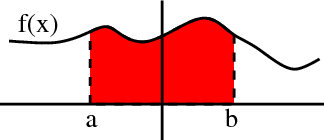
The integral is the area between the curve and the -axis.
In the same way, the double integral of positive can be interpreted as the volume under the surface over the region . Imagine that the blue object below is the surface floating above the -plane. The double integral can be interpreted as the volume between the surface and the -plane, i.e, the “cylinder” above the region .
You can also see this from the Riemann sum approximating the integral
Each term in the Riemann sum is the volume of a thin box with base and height .
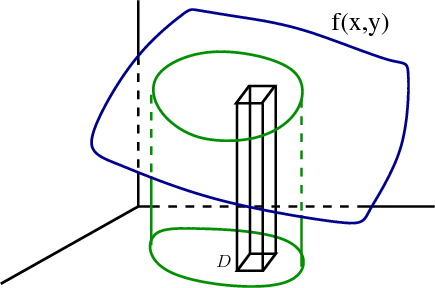
Hence, the total Riemann sum approximates the volume under the surface by the volume of a bunch of these thin boxes. In the limit as , we obtain the total volume under the surface over the region , i.e., .
The below applet illustrates how the volume of the boxes approaches the area under the surface as and decrease to zero.
If can you see how the double integral
is the volume between the surface and the surface ?
Example
Imagine if we had to find volume for
x^2 + y^2 = 9
x^2 + y^2 + z^2 =9, and
z = 0.
For rectangular coordinates, we can simply write this as,

For other coordinates we have,

Finally for spherical we have,

Example 2
Determine the volume of the region that lies behind the plane and in front of the region in the -plane that is bounded by and .
Here are the limits for each of the variables.
The volume is then,
Comments
Post a Comment